Top 5 Factors That Define High-Quality Dubbing in 2026

admin
blog


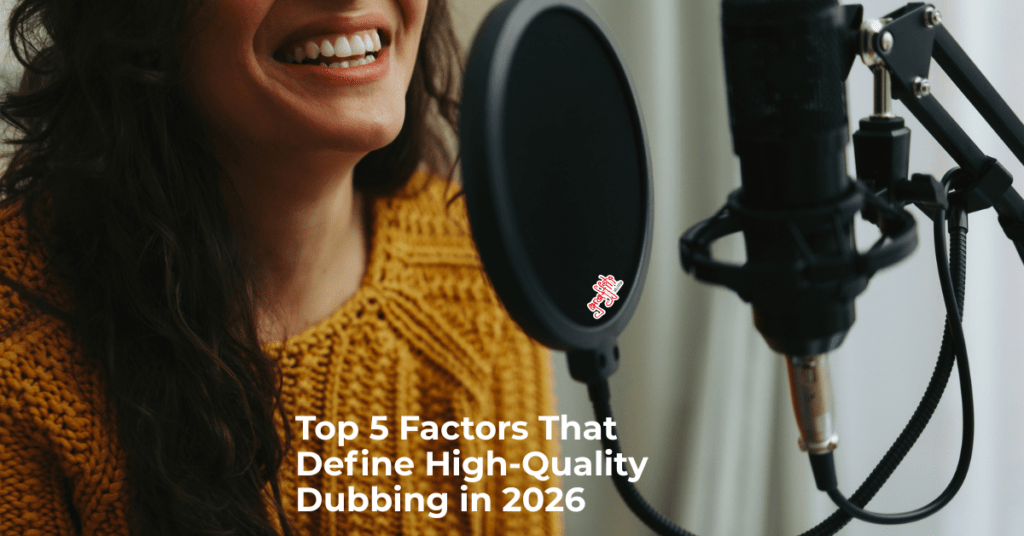
In 2026, high-quality dubbing is no longer judged only by whether the translated lines are accurate or whether the voices sound pleasant in isolation. The standard has become much higher. A strong dub now has to feel dramatically believable, technically smooth, tonally faithful to the original, and consistent enough to survive comparison with increasingly sophisticated global releases.
At the same time, artificial intelligence has made the market faster, cheaper, and more crowded, which means quality is now defined as much by judgment and control as by speed or scale. Industry reporting over the past year has repeatedly pointed to the same tension: AI adoption has accelerated, but trust, accuracy, and quality remain the dominant concerns, pushing the market toward hybrid human-led workflows rather than fully automated ones.
That is why great dubbing in 2026 is best understood as the result of several creative and technical decisions working together. It is not the product of one good voice, one clean translation, or one efficient studio session. It is a chain of quality, and the final result is only as strong as the weakest link in that chain.
The first defining factor of high-quality dubbing in 2026 is still the adapted script. This is where the dub either starts to feel alive or starts to feel compromised. Translation alone is never enough. A line may be semantically accurate and still fail as dubbing because it does not sound like something a real person would say in that emotional moment, within that visual rhythm, in that target language.
This is not a matter of style alone. It is structural. The adapted dialogue has to preserve creative intent while also working as speech. Current Netflix dubbing guidance places natural phrasing, colloquial language when appropriate, and the preservation of intent above mechanical literalism, and it makes clear that adapters are expected to reword lines to improve sync and audience experience rather than simply mirror the original wording.
In practice, this means that high-quality dubbing begins with text that can be performed. It must breathe naturally, carry tone without overexplaining it, and support timing without sounding forced. If that work is weak, everything that follows becomes more difficult. If it is strong, the rest of the dubbing process has a real foundation.
A second factor that increasingly defines dub quality in 2026 is the relationship between casting and direction. Audiences do care whether a voice feels right for the face, the age, the emotional register, and the energy of the character, but exact voice imitation is no longer the most useful standard. The stronger standard is credibility.
Netflix’s current dubbing principles make this point very directly: exact vocal matching is not always the primary goal of great casting, and performance should not be sacrificed merely to approximate surface vocal qualities when those qualities do not define the character. The director’s role is framed not as a scheduling function, but as a creative leadership role responsible for building a dub that feels unified, authentic, and aligned with the original artistic intention.
That distinction matters more in 2026 because audiences are increasingly sensitive to bad casting choices in a way they were not always encouraged to articulate before. A dub can be technically competent and still fail if the voice feels dramatically disconnected from the character. Likewise, a talented dubbing actor can still underdeliver if the direction is generic, underprepared, or too focused on line accuracy rather than emotional coherence.
High-quality dubbing therefore depends on two linked questions: was the right actor cast, and was that actor directed toward the right performance? When those two things align, the dub stops sounding like a replacement track and starts functioning as part of the work itself.
In 2026, lip sync on its own is no longer a sufficient description of technical excellence in dubbing. The stronger expectation is performance sync: a closer alignment not only with visible mouth movement, but with physical energy, breathing, attack, timing, and vocal projection.
This is also reflected in current dubbing guidance from Netflix, which explicitly frames exceptional sync as more than matching lip flaps. Their guidance emphasizes start and end mouth shapes, labials, vowel formations, and key moments, but also stresses that sync depends on energy, dynamics, breaths, and embodiment of the onscreen performance.
That broader view is especially important now because audiences are watching on better screens, comparing versions more easily, and consuming more dubbed content across genres. They are quicker to notice when a dub is visually “close enough” but emotionally out of time. A line can technically fit the mouth movement and still feel wrong if the breath lands late, the emphasis is misplaced, or the actor’s projection does not match the physicality of the scene.
This is also one of the places where automated dubbing still reveals its limits most clearly. Industry coverage in late 2025 and early 2026 has repeatedly pointed to prosody, tone control, and sync realism as areas where human intervention remains decisive for high-profile content, even as AI dubbing expands in lower-risk environments.
The implication is clear: in 2026, great dubbing is not defined by visual alignment alone, but by audiovisual credibility.
A fourth defining factor is the technical finish of the dub. This is the stage that many viewers notice only when it goes wrong, but it has enormous influence on whether the dubbing feels premium or patched together.
Clean recording remains the baseline. Netflix’s published technical guidance continues to stress high-quality preamps, careful microphone choice, minimal destructive processing during recording, removal of audible noises in editing, and immersive mixing that supports rather than isolates dubbed dialogue. For live-action lip-sync dubbing in particular, they explicitly encourage shotgun microphones and recording practices that better match the sound of the original production environment.
What matters here is not technical purity for its own sake. It is whether the voice sits naturally inside the world of the scene. A dub starts to feel cheap when the recording is too dry, too disconnected from the production sound, too aggressively cleaned, or mixed as though the dialogue exists separately from the rest of the soundtrack. By contrast, a high-quality dub feels embedded. The voice belongs to the space. The transitions are invisible. The viewer stops thinking about recording and simply experiences the scene.
In 2026, this kind of seamlessness matters even more because audiences increasingly compare dubbed versions across platforms, languages, and formats. Technical roughness that might once have passed unnoticed now reads immediately as lack of finish.
The fifth factor is the one that perhaps most clearly defines dubbing quality in 2026: not whether AI is present, but whether the overall workflow is controlled by people who know what quality sounds like.
The market has changed rapidly. AI dubbing and AI narration are now clearly part of the audiovisual localization landscape, especially in digital media, learning content, creators’ ecosystems, and other lower-risk or high-volume environments. At the same time, industry sources remain strikingly consistent on one point: trust, context, tone, and quality control continue to require human review, and premium content still depends on hybrid pipelines rather than raw automation.
This means that one of the clearest markers of high-quality dubbing in 2026 is workflow discipline. Who reviews the adaptation? Who signs off on casting? Who catches tonal drift between episodes? Who decides when a line should be rewritten rather than forced into sync? Who protects character consistency, performance continuity, and mix coherence?
A great dub now depends less on whether technology is used and more on whether the technology is governed. AI can accelerate preparation, draft generation, segmentation, and even synthetic voice layers in some contexts. What it cannot reliably replace is aesthetic judgment. It cannot independently decide what sounds dramatically credible, culturally natural, emotionally appropriate, and worthy of a premium release. That is still a human responsibility.
Taken together, these five factors define what high-quality dubbing means in 2026:
None of these factors works well in isolation. A strong cast cannot fully rescue weak adaptation. Precise sync cannot compensate for tonal miscasting. Clean audio cannot fix emotionally empty direction. Fast AI-assisted production cannot create trust on its own.
That is why the strongest dubs in 2026 are not simply the fastest, the cheapest, or even the most technically ambitious. They are the ones in which creative intention and technical control reinforce one another so completely that the audience stops noticing the mechanics. What remains is the illusion that the content simply belongs in that language.
And that, even now, is still the clearest sign of a truly high-quality dub.
At the same time, artificial intelligence has made the market faster, cheaper, and more crowded, which means quality is now defined as much by judgment and control as by speed or scale. Industry reporting over the past year has repeatedly pointed to the same tension: AI adoption has accelerated, but trust, accuracy, and quality remain the dominant concerns, pushing the market toward hybrid human-led workflows rather than fully automated ones.
That is why great dubbing in 2026 is best understood as the result of several creative and technical decisions working together. It is not the product of one good voice, one clean translation, or one efficient studio session. It is a chain of quality, and the final result is only as strong as the weakest link in that chain.
1. Adaptation that sounds spoken, not translated
The first defining factor of high-quality dubbing in 2026 is still the adapted script. This is where the dub either starts to feel alive or starts to feel compromised. Translation alone is never enough. A line may be semantically accurate and still fail as dubbing because it does not sound like something a real person would say in that emotional moment, within that visual rhythm, in that target language.
This is not a matter of style alone. It is structural. The adapted dialogue has to preserve creative intent while also working as speech. Current Netflix dubbing guidance places natural phrasing, colloquial language when appropriate, and the preservation of intent above mechanical literalism, and it makes clear that adapters are expected to reword lines to improve sync and audience experience rather than simply mirror the original wording.
In practice, this means that high-quality dubbing begins with text that can be performed. It must breathe naturally, carry tone without overexplaining it, and support timing without sounding forced. If that work is weak, everything that follows becomes more difficult. If it is strong, the rest of the dubbing process has a real foundation.
2. Casting and direction that prioritize performance over surface matching
A second factor that increasingly defines dub quality in 2026 is the relationship between casting and direction. Audiences do care whether a voice feels right for the face, the age, the emotional register, and the energy of the character, but exact voice imitation is no longer the most useful standard. The stronger standard is credibility.
Netflix’s current dubbing principles make this point very directly: exact vocal matching is not always the primary goal of great casting, and performance should not be sacrificed merely to approximate surface vocal qualities when those qualities do not define the character. The director’s role is framed not as a scheduling function, but as a creative leadership role responsible for building a dub that feels unified, authentic, and aligned with the original artistic intention.
That distinction matters more in 2026 because audiences are increasingly sensitive to bad casting choices in a way they were not always encouraged to articulate before. A dub can be technically competent and still fail if the voice feels dramatically disconnected from the character. Likewise, a talented dubbing actor can still underdeliver if the direction is generic, underprepared, or too focused on line accuracy rather than emotional coherence.
High-quality dubbing therefore depends on two linked questions: was the right actor cast, and was that actor directed toward the right performance? When those two things align, the dub stops sounding like a replacement track and starts functioning as part of the work itself.
3. Sync that includes rhythm, breath, and energy, not just mouth movement
In 2026, lip sync on its own is no longer a sufficient description of technical excellence in dubbing. The stronger expectation is performance sync: a closer alignment not only with visible mouth movement, but with physical energy, breathing, attack, timing, and vocal projection.
This is also reflected in current dubbing guidance from Netflix, which explicitly frames exceptional sync as more than matching lip flaps. Their guidance emphasizes start and end mouth shapes, labials, vowel formations, and key moments, but also stresses that sync depends on energy, dynamics, breaths, and embodiment of the onscreen performance.
That broader view is especially important now because audiences are watching on better screens, comparing versions more easily, and consuming more dubbed content across genres. They are quicker to notice when a dub is visually “close enough” but emotionally out of time. A line can technically fit the mouth movement and still feel wrong if the breath lands late, the emphasis is misplaced, or the actor’s projection does not match the physicality of the scene.
This is also one of the places where automated dubbing still reveals its limits most clearly. Industry coverage in late 2025 and early 2026 has repeatedly pointed to prosody, tone control, and sync realism as areas where human intervention remains decisive for high-profile content, even as AI dubbing expands in lower-risk environments.
The implication is clear: in 2026, great dubbing is not defined by visual alignment alone, but by audiovisual credibility.
4. Recording, editing, and mixing that disappear into the viewing experience
A fourth defining factor is the technical finish of the dub. This is the stage that many viewers notice only when it goes wrong, but it has enormous influence on whether the dubbing feels premium or patched together.
Clean recording remains the baseline. Netflix’s published technical guidance continues to stress high-quality preamps, careful microphone choice, minimal destructive processing during recording, removal of audible noises in editing, and immersive mixing that supports rather than isolates dubbed dialogue. For live-action lip-sync dubbing in particular, they explicitly encourage shotgun microphones and recording practices that better match the sound of the original production environment.
What matters here is not technical purity for its own sake. It is whether the voice sits naturally inside the world of the scene. A dub starts to feel cheap when the recording is too dry, too disconnected from the production sound, too aggressively cleaned, or mixed as though the dialogue exists separately from the rest of the soundtrack. By contrast, a high-quality dub feels embedded. The voice belongs to the space. The transitions are invisible. The viewer stops thinking about recording and simply experiences the scene.
In 2026, this kind of seamlessness matters even more because audiences increasingly compare dubbed versions across platforms, languages, and formats. Technical roughness that might once have passed unnoticed now reads immediately as lack of finish.
5. A managed human-led quality process, especially in the age of AI
The fifth factor is the one that perhaps most clearly defines dubbing quality in 2026: not whether AI is present, but whether the overall workflow is controlled by people who know what quality sounds like.
The market has changed rapidly. AI dubbing and AI narration are now clearly part of the audiovisual localization landscape, especially in digital media, learning content, creators’ ecosystems, and other lower-risk or high-volume environments. At the same time, industry sources remain strikingly consistent on one point: trust, context, tone, and quality control continue to require human review, and premium content still depends on hybrid pipelines rather than raw automation.
This means that one of the clearest markers of high-quality dubbing in 2026 is workflow discipline. Who reviews the adaptation? Who signs off on casting? Who catches tonal drift between episodes? Who decides when a line should be rewritten rather than forced into sync? Who protects character consistency, performance continuity, and mix coherence?
A great dub now depends less on whether technology is used and more on whether the technology is governed. AI can accelerate preparation, draft generation, segmentation, and even synthetic voice layers in some contexts. What it cannot reliably replace is aesthetic judgment. It cannot independently decide what sounds dramatically credible, culturally natural, emotionally appropriate, and worthy of a premium release. That is still a human responsibility.
What quality really means now
Taken together, these five factors define what high-quality dubbing means in 2026:
- adaptation that sounds spoken rather than translated;
- casting and direction built around believable performance;
- sync that includes rhythm, breath, and energy, not just mouth movement;
- recording, editing, and mixing that feel invisible inside the scene;
- a managed quality process in which human judgment remains central, even inside AI-enabled workflows.
None of these factors works well in isolation. A strong cast cannot fully rescue weak adaptation. Precise sync cannot compensate for tonal miscasting. Clean audio cannot fix emotionally empty direction. Fast AI-assisted production cannot create trust on its own.
That is why the strongest dubs in 2026 are not simply the fastest, the cheapest, or even the most technically ambitious. They are the ones in which creative intention and technical control reinforce one another so completely that the audience stops noticing the mechanics. What remains is the illusion that the content simply belongs in that language.
And that, even now, is still the clearest sign of a truly high-quality dub.